# Input:

1. Matrix of independent variables "X";
2. Matrix of response variable "y";Multiple Linear Regression and QSAR (Quantitative Structure–Activity Relationship)
Multiple linear regression is a statistical method used to model the effect of more than one independent variable on a response variable. In this case, the fitting procedure determines the influence of individual factors and their combined contribution to the dependent variable. QSAR, in turn, stands for Quantitative Structure–Activity Relationship. Essentially, it involves identifying structural features associated with a biological effect mediated by chemical compounds. By combining both approaches, QSAR can be addressed using a multiple linear regression framework.
1 Equation
The general function for a multiple linear model is:
\[ \hat{y}*{i} = b*{0} + b_{1}x_{i,1} + b_{2}x_{i,2} + \ldots + b_{k}x_{i,k} \]
The algebraic solution involves constructing the matrix containing the independent variables (with a unitary first column) and the response variable, followed by the determination of the coefficients \(\beta\) as:
\[
\beta = (X^T X)^{-1} (X^T y)
\]
The mlFIT program takes as input the matrices X and y, and returns the coefficients \(\beta\) along with statistical parameters associated with the regression.
2 Files
3 Usage and example
The program output includes:
# Output:

1. coef: regression coefficients;
2. se: standard errors of the coefficients;
3. qmreg: mean square of the regression;
4. sqres.sse: sum of squared errors (SSE);
5. qmres.s2: mean square of residuals;
6. sst: total sum of squares;
7. r2: coefficient of determination;
8. F: Snedecor’s F value;
9. pval: p-value of the regression.
The program includes an example (exQSAR) involving benzodiazepinone (TIBO) derivatives as reverse transcriptase inhibitors of the virus responsible for AIDS (Acquired Immunodeficiency Syndrome) (Tong et al., 2018).
To run the example, the list must first be unpacked using the EVAL command. The multiple linear regression applied to the example dataset is illustrated below:
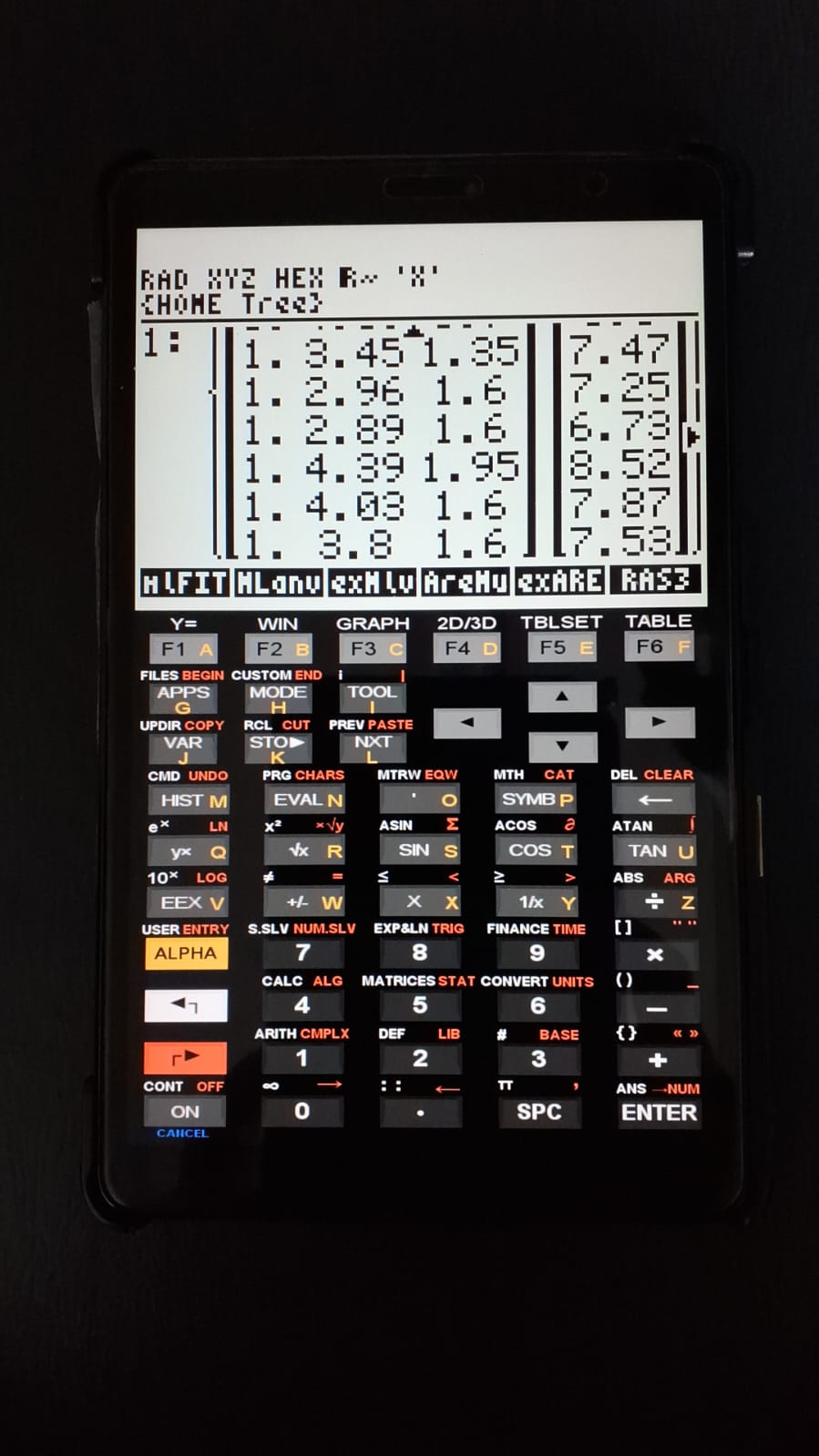
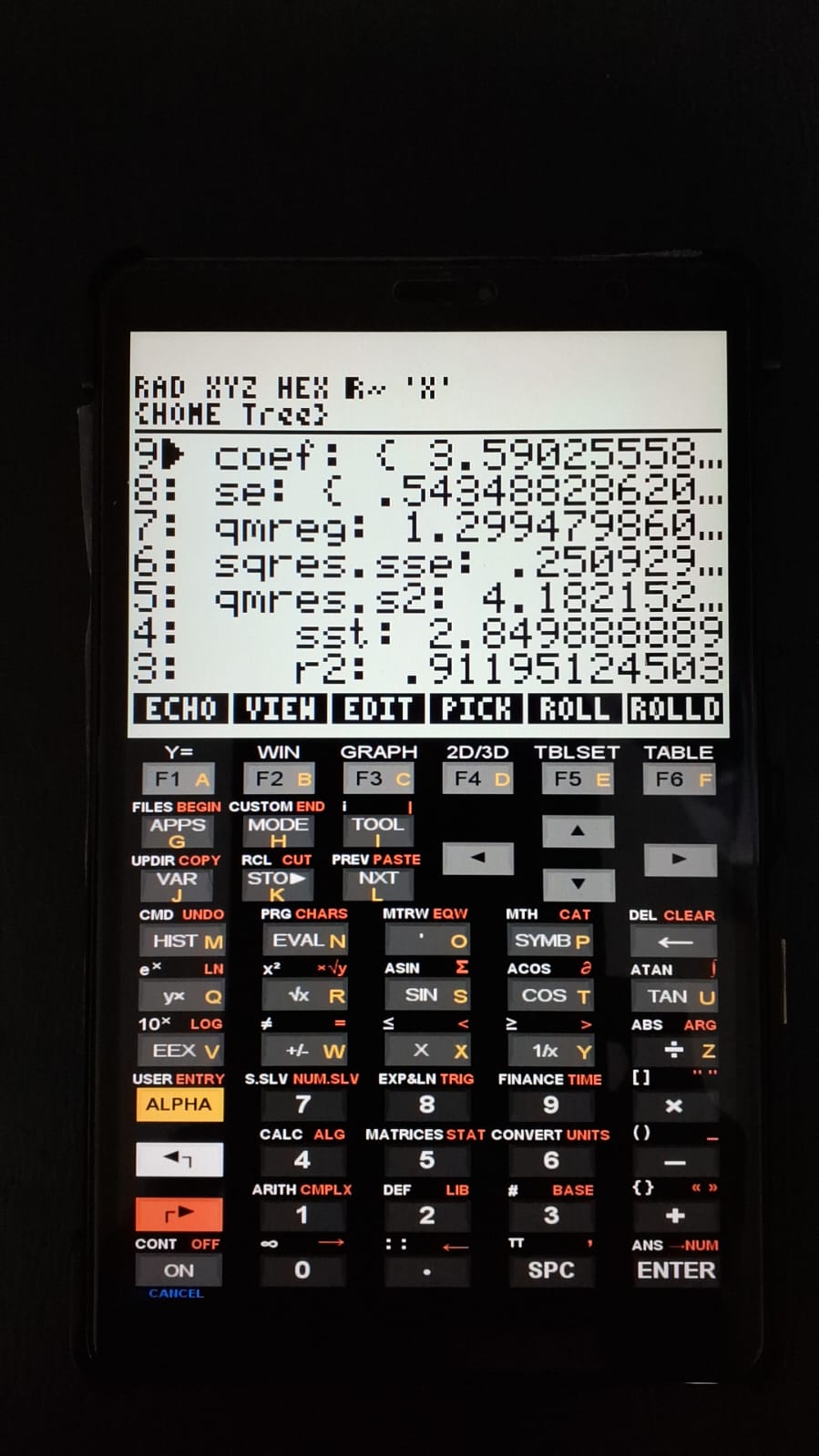
The coefficients obtained with mlFIT are consistent with those reported by the authors (Tong et al., 2018).
References
- Tong, Jianbo, et al. “QSAR studies of TIBO derivatives as HIV-1 reverse transcriptase inhibitors using HQSAR, CoMFA and CoMSIA.” Journal of Molecular Structure 1168 (2018): 56–64.