# Data input

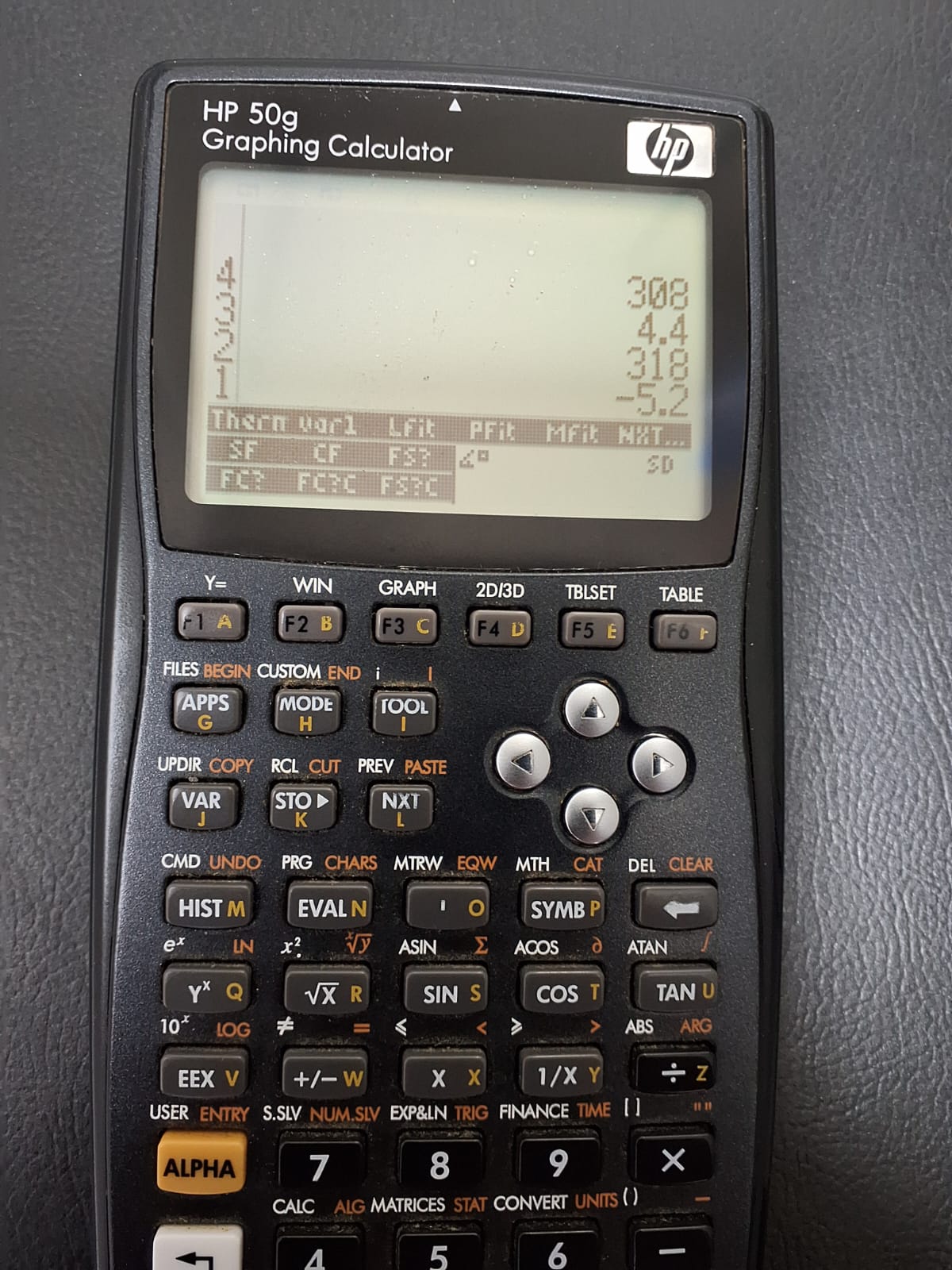
1. DeltaG_1, T1, DeltaG_2, T2;
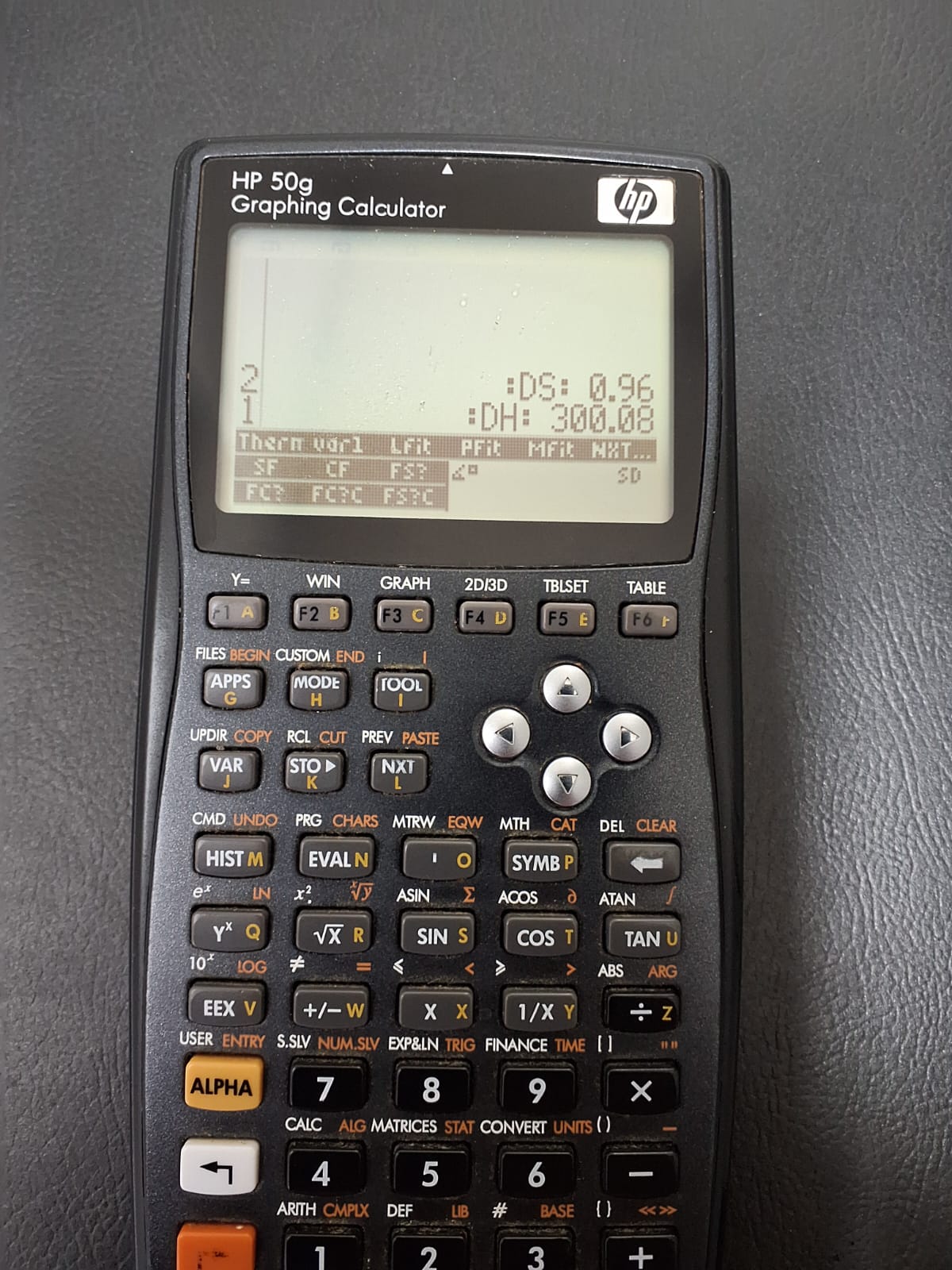
2. After selecting "Therm", the program computes the values of DeltaS and DeltaH.Therm – Thermodynamic Quantities via a Linear System at Two Temperatures
This program is intentionally simple, yet it allows the simultaneous calculation of \(\Delta S\) and \(\Delta H\) by linear algebra for a pair of reactions occurring at different temperatures, given known values of \(\Delta G\) (linear system of equations). It was developed using the newRPL firmware, although it can be easily adapted to the original HP50G firmware.
1 Equation:
\[ \Delta G^{T_1} = \Delta H - T_1 \cdot \Delta S \]
\[
\Delta G^{T_2} = \Delta H - T_2 \cdot \Delta S
\]
The solution is obtained via matrix algebra:
\[ A \cdot x = b \]
Where:
- A = matrix containing temperature values and a unitary first column;
- b = column matrix with \(\Delta G\) values;
- x = resulting matrix containing the parameters \(\Delta S\) and \(\Delta H\).
2 Files:
3 Usage:
To run the program, the following data must be entered sequentially on the stack:
4 Example
The figure below illustrates the HP50G with data input and the resulting stack output for the reaction described in Cooper (2011), as well as the newRPL firmware layout.
References
- Cooper, Alan. Biophysical Chemistry. Royal Society of Chemistry, No. 24, p. 113, 2011.