# Data input

1. After selecting "AIC", the program requests the following values (INPUT):
   n, kA, kB, ssA, ssB
2. After ENTER, the program computes:
"AIC_A, AIC_B, delta, prob.B"AIC – Akaike Information Criterion and Enzyme Inhibition
This program allows the calculation of parameters of the Akaike Information Criterion (Akaike, 2003) for the statistical discrimination between nonlinear models.
1 Equation:
\[ AIC = n \cdot \ln!\left(\frac{SSE}{n}\right) + 2k + \left[\frac{2k(k+1)}{n-k-1}\right] \]
Where:
- k = p + 1 (with p being the number of model parameters);
- SSE = sum of squared residuals from the fit.
\[
probab.B = \frac{e^{-0.5 \cdot \Delta AIC}}{1 + e^{-0.5 \cdot \Delta AIC}}
\]
Where:
- probab. B = probability that model B is better than model A (range 0–1);
- \(\Delta\)AIC = difference AIC\(_B\) − AIC\(_A\).
2 Files
3 Usage:
To run the program, the following data must be entered sequentially into the stack:
4 Example
The table and figures below refer, respectively, to enzyme inhibition data reported by Bezerra et al. (2013), and to the data input and output obtained for a pair of competing models.
Table 1 – Experimental enzyme inhibition data (n = 105). Source: Bezerra et al., 2013.
| Type | Control | Competitive | Pure non-competitive | Mixed non-competitive | Uncompetitive |
|---|---|---|---|---|---|
| SSE | 1540.1 | 613.1 | 1122.7 | 613.2 | 1436.4 |
| p | 2 | 3 | 3 | 4 | 3 |
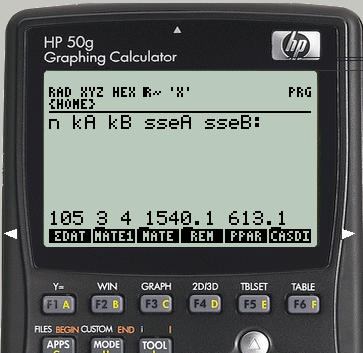
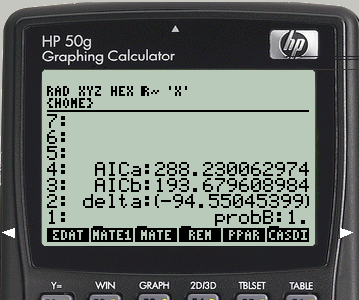
By running the AIC program, the following comparison results were obtained for selected pairs of models:
Table 2 — Results of model comparison using the AIC criterion.
| Model A / B | AIC\(_A\) | AIC\(_B\) | \(\Delta\) | Probab. B |
|---|---|---|---|---|
| Control / Competitive | 288.2 | 193.7 | -94.6 | 1.0 |
| Control / Mixed NComp. | 288.2 | 195.9 | -92.3 | 1.0 |
| Competitive / Mixed NComp. | 193.7 | 195.9 | 2.2 | 0.25 |
Based on these results, the probability associated with model B supports the selection of the competitive enzyme inhibition model, with a 75% likelihood over the mixed non-competitive model, in agreement with the conclusions reported by the authors.
References
Akaike, Hirotugu. A new look at the statistical model identification. IEEE Transactions on Automatic Control, 19(6), 716–723, 2003.
Bezerra, Rui M. F., Irene Fraga, and Albino A. Dias. Utilization of integrated Michaelis–Menten equations for enzyme inhibition diagnosis and determination of kinetic constants using the Solver supplement of Microsoft Office Excel. Computer Methods and Programs in Biomedicine, 109(1), 26–31, 2013.